
How to Prepare for 9th Class Board Exams 2027 – Complete Study Plan for Punjab Board
Hamza Khalid8 min read

How to Prepare for 9th Class Board Exams 2027 – Complete Study Plan for Punjab Board
Preparing for your 9th Class Board Examinations 2027? Starting early and following the right study strategy can make a significant difference in your examination performance.
Class 9 is an important stage in your academic journey. Students need to understand textbook concepts, practise MCQs, prepare short and long questions, and become familiar with the board examination pattern.
However, studying for long hours without a proper plan is not always effective. What matters most is consistency, smart revision and regular practice.
In this guide, Parho.online shares a practical study plan, subject-wise preparation tips and useful resources to help Punjab Board students prepare confidently for their 2027 examinations.
1. Start with the Latest 9th Class Smart Syllabus 2026–27
Before starting your preparation, understand what is included in your examination syllabus.
The Punjab Education, Curriculum, Training and Assessment Authority (PECTAA) has issued the revised Grade 9 Smart Syllabus for the academic session 2026–27 and BISE Annual Examination 2027.
Students should identify:
- Excluded chapters and topics.
- Deleted exercise MCQs.
- Excluded short questions.
- Excluded long questions.
- Remaining examinable textbook content.
Do not waste your preparation time by following outdated syllabus lists.
Check your subject-wise Smart Syllabus here:
9th Class Smart Syllabus 2026–27 – Parho.online
2. Create a Realistic Daily Study Timetable
A good timetable helps you distribute your study time across different subjects.
Instead of studying one subject for several hours, divide your time into manageable sessions.
Recommended daily study timetable
| Time | Study Activity | Duration |
|---|---|---|
| 4:00 PM – 4:45 PM | Mathematics | 45 minutes |
| 4:45 PM – 5:00 PM | Break | 15 minutes |
| 5:00 PM – 5:45 PM | Physics or Chemistry | 45 minutes |
| 5:45 PM – 6:00 PM | Break | 15 minutes |
| 6:00 PM – 6:45 PM | Biology or Computer Science | 45 minutes |
| 6:45 PM – 7:15 PM | Break | 30 minutes |
| 7:15 PM – 8:00 PM | English or Urdu | 45 minutes |
| 8:00 PM – 8:30 PM | MCQs and revision | 30 minutes |
This is a sample timetable. Adjust it according to your school schedule, subject requirements and personal study routine.
Important: Keep one day each week for revision, practice tests and completing unfinished topics.
3. Subject-Wise Preparation Strategy
Every subject requires a different preparation method. Focus on understanding the requirements of each subject instead of applying the same strategy everywhere.
Mathematics
Mathematics requires regular practice and a strong understanding of concepts.
Preparation tips:
- Understand formulas before solving questions.
- Practise textbook examples.
- Solve exercise questions independently.
- Memorize important mathematical identities.
- Practise questions involving calculations and steps.
- Review your mistakes regularly.
Do not simply read solved examples. Try solving questions without looking at their solutions.
Physics
Physics combines theoretical knowledge, numerical problems and conceptual understanding.
Preparation tips:
- Understand definitions and scientific concepts.
- Memorize important formulas and units.
- Practise numerical problems step by step.
- Prepare important short questions.
- Understand diagrams and practical applications.
- Practise conceptual MCQs.
Pay particular attention to numerical problems because they require both understanding and practice.
Chemistry
Chemistry requires a combination of conceptual learning, definitions, equations and scientific knowledge.
Preparation tips:
- Understand important chemical concepts.
- Learn definitions and terminology.
- Practise chemical equations.
- Prepare textbook short questions.
- Understand important examples and diagrams.
- Practise MCQs from every examinable topic.
Try to understand why a chemical reaction occurs instead of memorizing everything without understanding.
Biology
Biology involves terminology, processes, diagrams and detailed explanations.
Preparation tips:
- Understand biological processes.
- Learn important definitions.
- Practise labelled diagrams.
- Prepare textbook short questions.
- Revise scientific terminology.
- Practise MCQs regularly.
Use short notes to revise difficult processes and important biological terms.
Computer Science
Computer Science requires conceptual understanding, technical terminology and practical knowledge.
Preparation tips:
- Understand computer-related concepts.
- Learn important definitions.
- Practise MCQs.
- Prepare short and long questions.
- Understand algorithms and problem-solving concepts.
- Revise important textbook examples.
For Computer Science & Entrepreneurship, always follow the applicable revised syllabus for your subject.
English
English preparation requires reading, writing and grammar practice.
Preparation tips:
- Read textbook lessons carefully.
- Prepare questions and answers.
- Practise grammar regularly.
- Improve vocabulary and spelling.
- Practise translation and writing tasks included in your syllabus.
- Review your writing for grammatical mistakes.
Urdu
Urdu preparation requires regular reading and writing practice.
Preparation tips:
- Read textbook lessons carefully.
- Understand important explanations.
- Prepare textbook questions.
- Practise grammar and writing.
- Revise poetry and prose.
- Improve handwriting and presentation.
Islamiat
Islamiat requires understanding important concepts, references and prescribed textbook content.
Preparation tips:
- Understand the main concepts of each chapter.
- Prepare important short and long questions.
- Revise relevant Quranic references and Hadith included in your textbook.
- Practise MCQs.
- Review important terminology.
4. Give Special Attention to MCQs
MCQs are an important part of board examinations, and students should not leave their preparation until the last few days.
Many students focus heavily on long questions but neglect objective preparation.
A better strategy is to practise MCQs after completing every topic.
Follow this method:
- Read a topic carefully.
- Understand its important concepts.
- Attempt textbook exercise MCQs.
- Practise additional chapter-wise MCQs.
- Review incorrect answers.
- Repeat difficult questions during revision.
Do not memorize only the correct options. Understand why an answer is correct and why the other options are incorrect.
5. Prepare Short and Long Questions Properly
Written questions require clear concepts and well-organized answers.
Short questions
- Read the question carefully.
- Understand what is being asked.
- Include the relevant textbook information.
- Keep answers clear and focused.
- Use scientific terminology where necessary.
- Avoid unnecessary explanations.
Long questions
- Understand the complete topic.
- Divide answers into logical headings.
- Include relevant diagrams where required.
- Explain important points in the correct sequence.
- Practise writing answers within the available examination time.
Regular written practice will improve both speed and answer presentation.
6. Use Pairing Schemes and Model Papers
Pairing schemes and model papers are useful resources for understanding the examination format.
The revised Grade 9 examination resources provide subject-wise pairing schemes and model papers.
A pairing scheme helps students understand the distribution of questions across chapters, while a model paper provides an example of the examination structure.
Use them as preparation tools, not as replacements for the textbook.
Before attempting a model paper:
- Complete the relevant examinable syllabus.
- Understand the pairing scheme.
- Review important textbook questions.
- Attempt the model paper without assistance.
- Check your answers.
- Identify weak areas and revise them.
7. Follow a Three-Phase Revision Strategy
Organize your preparation into three phases.
Phase 1 – Complete the Syllabus
Focus on understanding every examinable topic.
- Read textbook chapters.
- Prepare notes.
- Practise exercise questions.
- Learn definitions and formulas.
- Identify difficult topics.
Phase 2 – Practice and Improve
Once you have covered the syllabus, focus on testing your knowledge.
- Attempt chapter-wise MCQ tests.
- Solve short and long questions.
- Practise numerical problems.
- Attempt model papers.
- Maintain a list of mistakes.
Phase 3 – Final Revision
Use your remaining preparation time wisely.
- Revise important definitions.
- Review formulas and diagrams.
- Practise difficult MCQs.
- Review frequently made mistakes.
- Attempt timed examination papers.
- Avoid leaving unfamiliar topics until the final days.
8. Common Mistakes to Avoid During Board Preparation
Even hardworking students sometimes lose marks because of poor preparation habits.
Avoid these mistakes:
Studying Without a Plan: Random study sessions make it difficult to complete the syllabus.
Ignoring MCQs: Objective questions need regular practice.
Memorizing Without Understanding: Memorized information is difficult to apply to conceptual questions.
Skipping Written Practice: Reading answers is not the same as being able to write them independently.
Using Outdated Syllabus Information: Always check the latest official syllabus.
Leaving Revision Until the Last Week: Regular revision helps students retain information.
Ignoring Time Management: Practise completing questions within the examination time.
9. Free Study Resources for Class 9 Students
Finding the right study resources can make examination preparation easier.
At Parho.online, students can explore educational resources for their board examinations.
Available learning resources include:
- Chapter-wise MCQ tests.
- Short questions with answers.
- Long questions with answers.
- Subject-wise study notes.
- Smart Syllabus and deleted topics.
- Pairing schemes.
- Past papers and model papers.
- Textbooks and educational resources.
- Online practice tools.
Explore the Class 9 Smart Syllabus:
https://www.parho.online/smart-syllabus/class-9
Visit the main website for more study resources:
10. Frequently Asked Questions (FAQs)
Q1. How many hours should a 9th class student study daily?
There is no fixed number of hours for every student. A consistent routine of focused study sessions, adjusted to school timings and individual needs, is more useful than studying for long hours without concentration.
Q2. When should I start preparing for the 9th Class Board Exams 2027?
Start as early as possible. Completing topics gradually gives you enough time for practice and revision.
Q3. Is the 9th Class Smart Syllabus 2026–27 important?
Yes. It identifies excluded content for the 2027 examination. Students should check the official subject-wise documents before preparing.
Q4. Should I practise MCQs every day?
Yes. Regular MCQ practice helps improve accuracy, strengthen concepts and identify weak areas.
Q5. Are pairing schemes enough to prepare for board exams?
No. Pairing schemes help explain the paper structure, but students should prepare the complete examinable syllabus and practise textbook questions.
Q6. Where can I find Class 9 study material online?
You can explore study notes, chapter-wise tests, MCQs, syllabus updates and other educational resources at Parho.online.
Conclusion
Success in the 9th Class Board Examination 2027 depends on consistent preparation, a realistic timetable, conceptual understanding and regular practice.
Start by checking the latest Smart Syllabus, divide your subjects into manageable study sessions, practise MCQs and written questions, and use model papers to evaluate your preparation.
Remember that smart preparation is not about studying all day. It is about studying with a clear plan and making consistent progress.
Start your preparation today with Parho.online.
Visit Parho.online – Your Partner in Education
Study Smart. Score High!
Keep reading
 9th Class Smart Syllabus 2026–27 Punjab Board – Official PDFs, Deleted Topics & Pairing SchemesThe Grade 9 Smart Syllabus 2026–27 has been announced by PECTAA for BISE Annual Examinations 2027. Explore official syllabus PDFs, deleted topics, exercise questions, pairing schemes and model papers.
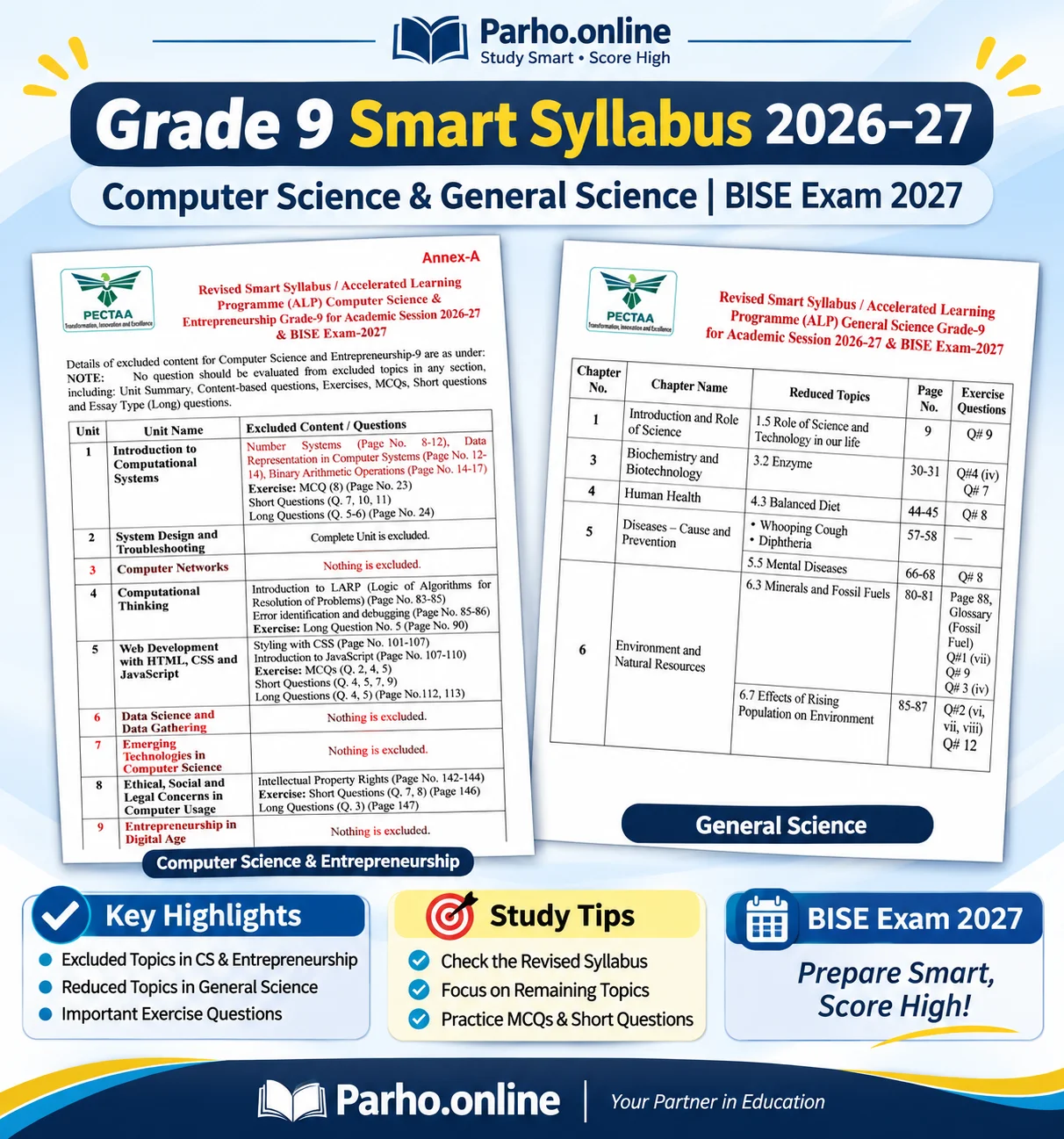 Grade 9 Smart Syllabus 2026–27 – Computer Science & General Science | BISE Exam 2027Check the revised Grade 9 Smart Syllabus 2026–27 for Computer Science & Entrepreneurship and General Science. Find excluded topics, reduced chapters, exercise questions and important details for BISE Exam 2027.
 How to Score High Marks in Punjab Board ExamsLearn practical strategies to score high marks in Punjab Board examinations. Improve your preparation, manage time, practise past papers and avoid common examination mistakes.